Beautiful arrangements. A loyal customer base. An outdated website. Here's why your flower shop is losing online - and exactly what it's costing you.
A Thriving Industry With a Crumbling Digital Foundation
The global cut flower market was valued at $21.82 billion in 2024 and is on track to reach nearly $33 billion by 2030. Meanwhile, the average independent florist's website hasn't been meaningfully updated since 2018.
There's no shortage of demand. Consumers are buying more flowers than ever - for weddings, gifting, home décor, and self-care. Online flower purchases have surged by 25% year-over-year in recent periods, and mobile transactions for flower orders have jumped 40%. The customers are searching. They're ready to buy. But too many independent florists simply aren't showing up - digitally speaking.
The painful irony is this: the florist industry is built on emotional connection, beauty, and experience - exactly the things that translate powerfully online when done right. Yet the digital infrastructure behind most independent flower shops is fragile at best, and invisible at worst.
Independent florists are losing ground to national chains and online retailers. The gap is not creativity - your arrangements are probably better. It's the operational and digital tools that power a modern retail business. - Digital Florists Industry Analysis, 2024
The Society of American Florists' most recent industry data paints a picture of a sector navigating economic headwinds - rising import costs, increased tariffs on floral imports, inflation-weary consumers, and a staffing crisis - all while the digital transformation train has long since left the station. The shops that will thrive in the next decade aren't necessarily the most talented designers. They're the ones who figure out how to be found, trusted, and bought from online.
What's Hurting Florist Businesses Right Now
Across industry surveys, agency audits, and SAF member data, the same pain clusters appear again and again. They fall into three buckets: business operations, supply chain economics, and - critically - the digital gap.
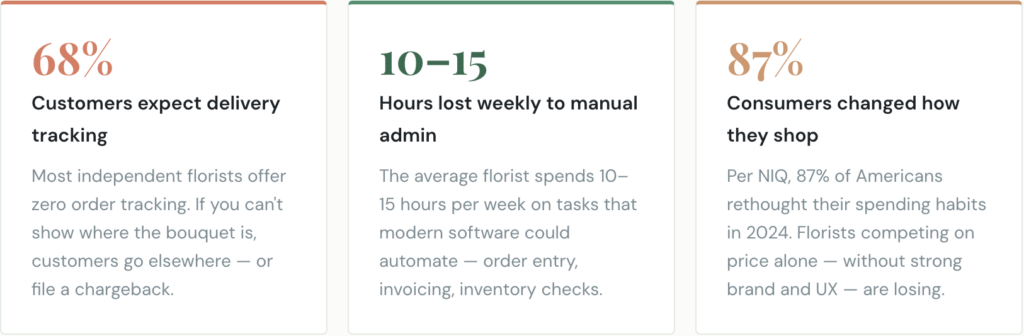
Inventory management remains a persistent nightmare. Flowers are perishable - every unsold stem is lost revenue, and every stockout is a failed customer. Without real-time inventory systems, florists routinely over-buy for peak periods (Valentine's Day, Mother's Day) and under-buy for mid-season demand. A 2024 industry survey found that 51% of florists rank inventory (the "Stem Counter") as their second highest operational priority, yet most are still managing it with spreadsheets or memory.
Pricing strategy is another landmine. Industry data shows florists applying markups ranging from cost × 3 (36%) to cost × 4 (30%) - but without standardized pricing tools, inconsistency bleeds profitability. In a market where consumers are 17% more price-sensitive than in 2023, an incoherent pricing presentation online can be the difference between a sale and a bounce.
7 Biggest Problems With Florist Websites in 2026
We audited florist websites across the US and Europe in 2025 found the same critical failures repeating across the industry. These aren't minor annoyances - each one directly costs sales.
1. Not Mobile-Optimized - In a 60% Mobile World
Over 60% of all searches now happen on mobile. Mobile transactions for flower orders have risen 40% in recent years. Yet the majority of independent florist websites were designed for desktop - tiny tap targets, images that don't resize, and checkout flows that are nearly impossible to complete on a phone.
A non-mobile-friendly site loses most of its search traffic before a single product page loads. Google's mobile-first indexing means your desktop-built site is effectively invisible to the algorithm.
2. Invisible in Local Search (The #1 Revenue Leak)
46% of all Google searches have local intent. When someone searches "florist near me" or "same-day flower delivery [city]", they almost never scroll past the first three results — the Local 3-Pack. Florists without an optimized Google Business Profile, consistent NAP citations, and location-specific landing pages simply don't exist to that searcher.
Common mistakes: outdated or unclaimed GBP listings, missing service descriptions, no photos uploaded in 6+ months, and zero strategy around reviews. 56% of consumers won't buy from a business with fewer than 4 stars - yet most florists have no system for collecting reviews at all.
3. Slow, Outdated Website Design
The average florist site loads in 7-10 seconds. Industry benchmarks show a 1-second improvement in load time can lift conversions by 2%. Many florist websites are running on template builders that haven't been updated since 2017 - bloated code, uncompressed images, and no performance optimization.
Speed isn't just a user experience issue. It's a direct Google ranking signal. A slow site drops in search results and bounces visitors before they see a single product.
4. Frictionless Checkout - You Still Don't Have It!
The global average cart abandonment rate in 2025 is 70.19%. In the floral space, this number is likely higher - most florist ecommerce checkout flows require account creation, multiple steps, and don't support one-tap payment options like Apple Pay, Google Pay, or Shop Pay.
53% of global shoppers now use digital wallets. A florist whose checkout doesn't support these options is asking customers to type in credit card numbers on a mobile phone - most won't. One step is all you need!
5. No Real Product Photography or Visual Strategy
Flowers are a completely visual product. Buying a bouquet online is an act of trust - the customer is trusting that what arrives matches what they saw. Yet many florist websites use stock photos, low-resolution snapshots, or images from their wholesale catalog. Worse, 92% of florists do weddings - but few have dedicated, well-photographed wedding gallery pages with SEO-optimized content.
Properly named, alt-tagged, high-quality images aren't just conversion drivers - they're an SEO asset. Images rank in Google Image Search and attract high-intent buyers searching by style, color, or occasion.
6. No Email List, No Retention Strategy
The most expensive customer is a new one. Yet most florist websites have zero email capture — no pop-up, no loyalty offer, no post-purchase follow-up sequence. Flowers are a repeat purchase category: birthdays, anniversaries, holidays, grief. A customer who bought from you in March for Valentine's Day is a near-certain buyer again in May for Mother's Day - if you stay in their inbox.
Industry data shows that 44% of florists don't participate in any advertising at all. The ones who do are largely relying on WeddingPro (24%) or Zola (16%) - platforms that own the customer relationship, not the florist.
7. No Content, No Trust, No Conversion
Most florist websites are digital brochures: a homepage, a shop page, a contact form. There's no blog, no care guides, no "how to order a wedding consultation" page, no FAQs about delivery. This is a missed opportunity on two fronts: SEO (Google rewards informative, regularly-updated content) and trust-building (first-time buyers need more than a product grid to commit to a purchase).
A florist who publishes a monthly post on seasonal arrangements, flower care tips, or local wedding venue partnerships is building compounding organic traffic that costs nothing after the initial effort.
What a Modern Florist Digital Presence Actually Looks Like
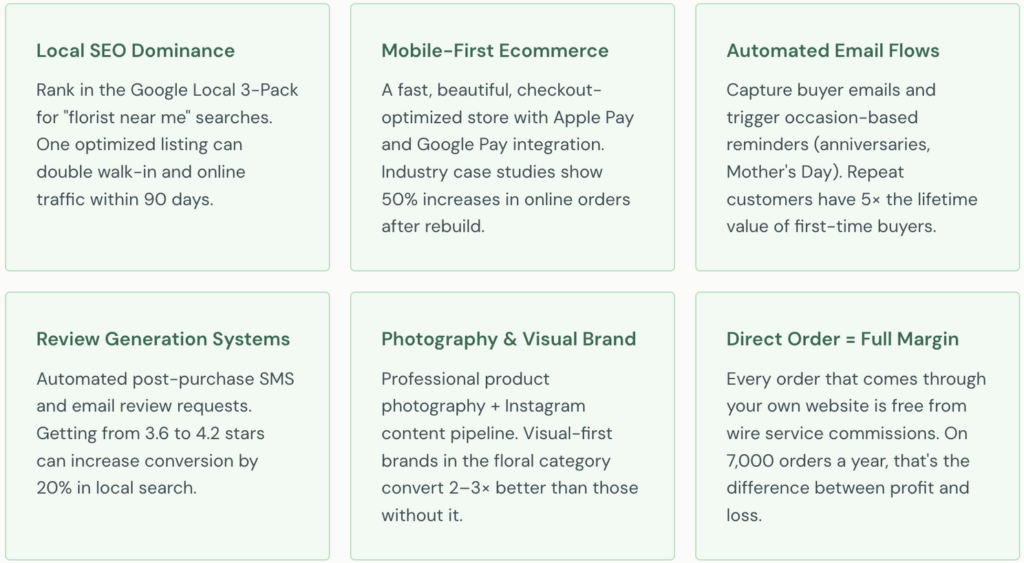
The gap between where most florist websites are and where they need to be is large - which is precisely the opportunity. The independent florist who closes this gap in their market doesn't just survive; they dominate. Here's what a fully realized digital strategy delivers:
The Florists Who Act Now Will Own Their Markets
In 10 years, every successful florist will be running on modern digital infrastructure. The question is whether they build it now - or watch a competitor do it first.
The floral industry is not dying. Consumer demand for flowers remains emotionally resilient across economic cycles - flowers are tied to life's biggest moments, and no economic downturn eliminates birthdays, weddings, or grief. The market is growing at nearly 7% annually. The opportunity is genuine and large.
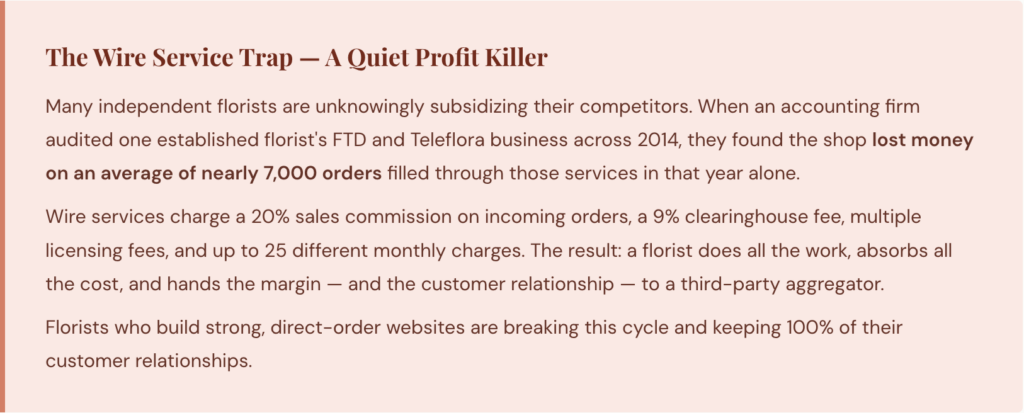
But the independent florist operating on an eight-year-old website, spending 12 hours a week on paper order forms, and paying FTD 29% of every order is not competing in that growth market. They're watching it from the sideline while 1-800-Flowers, Teleflora, and well-funded local competitors capture the digital customer.
A focused digital investment - the right website platform, local SEO, a mobile checkout experience, email automation, and a direct-order strategy - is not a luxury for florists in 2026 and beyond. It's the cost of staying in business. And for those who move first, it's a significant and durable competitive moat.
If you're trying to outrun your competition, start the conversation with the experts in the industry!